


- Food Waste FAQs
Food Waste FAQs
FAQ’s
Why are we introducing food waste collections?
Food waste collections are being introduced in response to the Environment Act 2021, which requires local authorities to:
- Deliver weekly household food waste collections
- Implement “Simpler Recycling”, ensuring consistency in recycling services across England.
These changes are intended to:
- Increase recycling rates
- Reduce the amount of food waste sent for energy recover
- Support the Government’s wider environmental and climate commitments
- Ensure recycling consistency across England
How does this link to Simpler Recycling?
Simpler Recycling expands the range of materials residents can recycle.
In Broxtowe:
From 31 March 2026, residents can place the following additional items in their recycling bins:
- Plastic Pots, tubs and trays
- Foil
- Tetra Pak cartons
The introduction of weekly food waste collections is another mandatory element of Simpler Recycling.
When will food waste collections start in Broxtowe?
While the national deadline for implementing weekly food waste collections was 31 March 2026, Broxtowe Borough Council, along with the other Nottinghamshire district councils, has a transition agreement in place. As a result:
- Borough wide food waste collections will begin on 1 October 2027
This approach allows councils to work collaboratively, manage costs, and learn from local trials before full implementation.
Is Broxtowe Borough Council running a food waste trial?
Yes.
To support learning and inform the Borough wide rollout, the Council will run a pilot trial.
Trial details:
Start date: 16 October 2026
Number of properties: Approximately 1,700 households
Purpose:
- To test how food waste collections operate in practices
- To understand impacts on residual (black bin) waste volumes and weights
- To identify operational issues and customer behaviours ahead of full roll out
How will the trial be evaluated?
The trial will include a robust evaluation programme, including:
- Pre trial resident survey
- Mid trial survey to understand behaviour change and customer experience
- Waste compositional analysis, supported by Nottinghamshire County Council
Monitoring of key performance indicators (KPIs), including:
- Participation levels
- Capture of food waste
- Impact on residual waste volumes and weights
Learning from these activities will directly inform:
- Service design
- Communications and engagement
- Borough wide rollout planning in 2027
What containers will households receive?
Standard households
Each participating household will receive:
- Black 23 litre external food waste caddy (for external collection)
- Silver 7 litre internal kitchen caddy
Flats and Houses in Multiple Occupation (HMOs)
- A 140 litre communal food waste bin will be provided for external collection
- Each flat or household unit will still receive its own 7 litre internal caddy
Will food waste liners be provided?
No.
The Council will not provide liners for internal kitchen caddies.
Residents may:
- Use any standard plastic bag (e.g. bread bags, cereal bags, carrier bags)
- Purchase food waste liners independently if they prefer
Why aren’t compostable liners provided?
While compostable liners may appear environmentally friendly, the treatment facility has advised that:
- When compostable liners get wet, they become sticky and difficult to separate
- This causes problems in the waste processing system
- Conventional plastic bags are easier to remove from the food waste stream and support more efficient processing.
Do residents have to use a liner?
No.
Using a liner is optional, but it can:
- Help keep the internal caddy cleaner
- Reduce odours and residue
Residents may choose whichever approach works best for them.
How often will food waste be collected?
Food waste will be collected weekly.
It will be collected on the same day as the household’s scheduled waste or recycling collection, alongside whichever bin is being presented that week.
What food items can go in the food waste bin?
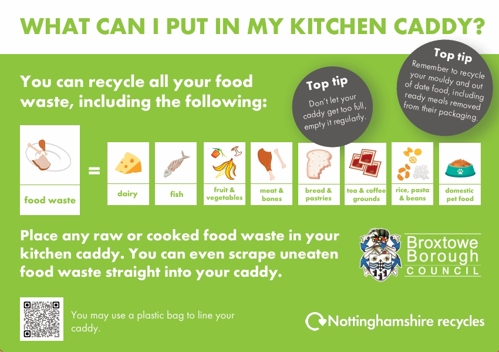
Almost all food waste can be included, including:
- Plate scrapings
- Cooked and uncooked food
- Meat and fish (including bones)
- Dairy products
- Bread, rice, pasta
- Egg shells
- Pet food
- Out of date food (removed from packaging)
Important reminder:
Packaging must be removed before food is placed in the caddy.
Are there any tips for using the service?
Yes. Key tips include:
- Do not wait for the caddy to be full before emptying it
- Emptying the caddy regularly helps prevent smells and pests
- Keeping on top of emptying is especially important in warmer weather
What stickers or guidance will residents receive?
As part of both the trial and full rollout:
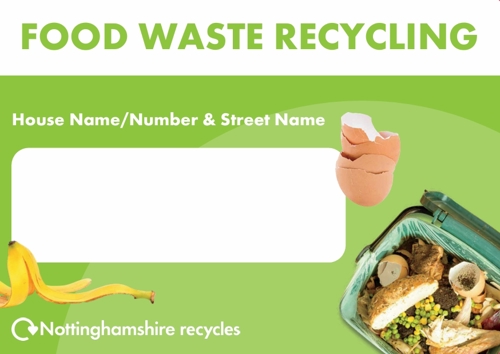
- A property name/number sticker will be provided for the external caddy or bin lid
- An internal “what can and can’t go in” sticker will be placed on the kitchen caddy to support correct use
- A leaflet detailing how the scheme and collections will work.
Internal Caddy Sicker
External Container sticker
What happens to the food waste once it has been collected?
All food waste collected as part of the trial and the future borough wide service will be sent to BioDynamic’s anaerobic digestion facility at Colwick, Nottingham.
At the facility, food waste is treated using anaerobic digestion (AD). This is a natural biological process where food waste is broken down in sealed, oxygen free tanks.
The process produces:
- Biogas, which is used to generate renewable electricity and heat, and
- Digestate, a nutrient rich fertiliser that can be safely returned to agricultural land.
- This means food waste is turned into useful energy and soil nutrients, rather than being destroyed as residual waste.
Why is food waste recycled through anaerobic digestion instead of incineration?
Food waste is around 70% water, which makes it inefficient to burn. Incinerating food waste requires additional energy to dry it out before it can combust efficiently.
Anaerobic digestion is a far better option because:
- It is specifically designed for wet organic material
- It captures energy in the form of biogas rather than releasing it as heat waste
- It avoids the need to burn food waste altogether
For these reasons, both WRAP and Government policy recognise anaerobic digestion as the preferred treatment option for separately collected food waste.
What are the carbon benefits of recycling food waste this way?
Recycling food waste through anaerobic digestion delivers significant carbon savings when compared with incineration or landfill.
Key climate benefits include:
- Avoided methane emissions: When food waste decomposes in landfill or residual waste streams, it releases methane, a greenhouse gas over 20 times more potent than CO₂. AD captures this methane and uses it as energy instead.
- Displacement of fossil fuels: Biogas produced from food waste replaces natural gas and other fossil fuels used for electricity and heat.
- Reduced fertiliser emissions: Digestate replaces manufactured fertilisers, which are highly carbon intensive to produce.
Studies consistently show that separate food waste collection with AD treatment results in substantially lower net greenhouse gas emissions than incineration, making it one of the most cost effective waste carbon reduction measures available to councils.
How does this compare with incineration in carbon terms?
Incineration:
- Emits direct CO₂ when waste is burned
- Is less efficient for wet wastes like food
- Does not return nutrients to soils
Anaerobic digestion:
- Produces renewable energy with lower lifecycle emissions
- Prevents methane leakage from decomposition
- Supports a circular economy by returning nutrients to farmland
As a result, AD delivers greater overall carbon savings per tonne of food waste than energy from waste incineration facilities.
Is food waste disposal cheaper than disposing of it in the black bin?
Yes.
Treating separately collected food waste through anaerobic digestion is generally cheaper than disposing of it as residual waste.
According to WRAP’s most recent UK gate fee data:
- Anaerobic digestion gate fees are typically lower than energy from waste (incineration) gate fees
- In some areas, councils pay very low gate fees for food waste treatment, depending on contracts and capacity
- Incineration costs are expected to increase further due to the expansion of the UK Emissions Trading Scheme (ETS)
This means diverting food waste from the black bin can:
- Reduce disposal costs
- Reduce exposure to future cost increases
- Improve overall waste system efficiency.
Does recycling food waste reduce black bin waste?
Yes.
Food typically makes up around a quarter to a third of household residual waste by weight.
Removing it:
- Frees up capacity in black bins
- Reduces bin weights
- Improves the overall performance of the waste service
This is one of the key areas the trial will monitor, through waste compositional analysis and ongoing performance data.
What if I don’t produce much food waste?
That’s absolutely fine. Some households produce very little food waste, while others produce more. There is no minimum amount of food waste required, and recycling even small amounts helps reduce environmental impact.
Do residents have to take part in the food waste collection?
No – participation is voluntary.
However, the service:
- Helps free up space in the black bin
- Is better for the environment
- Is part of the Council meeting its legal duties
Will the food waste bin smell?
When used correctly, food waste bins should not smell.
To minimise odours:
- Empty the kitchen caddy regularly
- Keep lids closed
- Do not wait until the caddy is completely full
- Use a liner if you choose to
Weekly collections are specifically designed to prevent food waste being stored for long periods.
Will food waste collections attract pests?
No, provided the bin is used correctly.
The external food waste caddies:
- Are sealed
- Have secure, close fitting lids
Residents should:
- Keep lids closed
- Not overfill the bin
- Avoid leaving food waste loose on top of the bin
This approach has been successfully used by many councils across England.
What should residents do in hot weather?
In warmer weather, residents are advised to:
- Empty the kitchen caddy more frequently
- Keep the lid closed at all times
- Store the kitchen caddy in a cool place if possible
These simple steps help prevent smells and keep the service hygienic.
Do I need to rinse or wash the caddy?
Rinsing is not required, but occasional cleaning can help keep the caddy fresh.
Residents may choose to:
- Rinse the caddy with water
- Wipe it out periodically
Using a liner can also make cleaning easier.
What happens if the food waste bin is contaminated?
Food waste collections rely on good quality material.
If the bin contains:
- Packaging
- Plastic, glass or other non food waste
- Garden waste or large amounts of liquid
It will not be collected. In these cases:
- The bin will be tagged with a contamination label explaining why it was not collected.
- The contamination will be recorded by the collection crew using the in cab system.
What residents should do next will depend on the level of contamination:
- If contamination is minor, residents should remove the incorrect items and present the bin again for collection the following week.
- If contamination is more significant, residents may choose to empty the contents into their black bin, clean the food waste caddy, and start again.
Clear stickers and guidance will be provided on both the internal and external caddies to help residents put the right materials in the right bin.
What if a household already receives assisted collections?
Households that already receive assisted collections will continue to receive support.
Food waste collections will be provided in line with existing assisted collection arrangements, so residents do not need to make additional requests if they already qualify.
What if a household doesn’t have space for a kitchen caddy?
Most households find the 7 litre kitchen caddy fits:
- Under the sink
- In a cupboard
- On the worktop if preferred
Residents may also choose to use an alternative small container that suits their kitchen layout, provided food waste is transferred to the external caddy for collection.
Will food waste be collected by the same crew as other bins?
Food waste will be collected as part of the weekly waste service using appropriate collection vehicles and arrangements.
Collections will take place on the same scheduled collection day as other household bins, making it as simple as possible for residents to remember to put it out.
Will this service cost residents anything?
No.
Food waste collections and containers are provided as part of the Council’s statutory waste services. Residents are not charged for taking part.
I already compost my food waste at home. Do I need to stop and use the kerbside food waste collection instead?
No. Residents who already compost their food waste at home are encouraged to continue doing so. Home composting is an excellent way to recycle food waste and create compost for use in the garden. There is no requirement to use the kerbside food waste collection service for food waste that is composted at home.